Redefining Chaos Engineering with NetHavoc


Get in Touch
-
To More Inquiry
+1-800-701-6125
-
To More Inquiry
salesone@cavisson.com
-
Noida, India
- Home
- Introduction to Service Virtualization
Introduction to Service Virtualization
Blog


By, Parul P
- 13 May, 2026
- 57 Views
- 0 Comment
Overview
The process of creating replicas of systems on which new applications rely is known as service virtualization. This assesses how well these systems and the software application can work together. Software applications that depend on cloud services, service-oriented architectures (SOA), or those that require communication with external data and application program interfaces (APIs) will find it especially useful for integration. To provide high-quality software applications, the Software Development Life Cycle requires operations, testing, and development teams to work seamlessly together. That, too, must be error-free, within budget, and on schedule.
However, joining the actual world can provide a different obstacle. For example, various dependent components, such as networks, APIs, databases, and devices, must be prepared with suitable configuration, test data, and functionality in order for test cases to run successfully.
Service Virtualization Definition
Service virtualization, or SV, is a popular software testing and development technique that simulates dependent services or system behavior that may be unavailable or partially functioning during testing and development. Both developers and testers can readily create virtual representations of such dependencies, simulating their behavior and function. These representations are often known as virtual services. Dependence on third-party systems, APIs, databases, and automated external services is unavoidable in the case of complexities and software applications. Although they may not be ready for testing or accessible while development is underway, service virtualization allows you to imitate their functionality. It significantly aids in the removal of this impediment.
Why Is Service Virtualization Important?
When testers and developers opt to establish virtual services, they can replicate their actual behaviors and replies. It also makes it easier to interact with these virtual services in the same manner that we do with actual ones. This continues despite the restrictions or unavailability of real services. Virtual services can be customized to simulate diverse scenarios, such as data changes, error conditions, and response times, allowing for extensive software testing under a variety of situations.
- Testing and development: Because SV provides a virtual representation of dependent services or systems, teams can simultaneously build and test software applications without being completely reliant on real systems. This approach aids in identifying and correcting issues in the early stages of the development cycle. As a result, it lowers integration and testing costs and timelines.
- Continuous Integration and Continuous Delivery: CI/CD is an important aspect of today’s software development paradigm. Teams may simply create virtual replicas of any dependent systems or services using SV, making it easier to write software, test it, and deploy applications consistently without wasting time. In other words, you don’t have to wait for the services to be available. Some benefits of this strategy include faster software updates, delivery, and feedback cycles.
- Optimizing resources and costs: When it comes to the actual world, many services have severe usage limitations, restricted availability, and exorbitant fees. SV eliminates the need to directly access such services during testing and development, decreasing reliance on resources and expenses. You may effortlessly distribute them across different contexts and teams, maximizing the utilization of varied resources.
- Parallel development and testing: When systems are complex, numerous teams collaborate on multiple components while relying on interconnected services. Service virtualization makes parallel testing and development easier by providing virtual representations and eliminating reliance on the reliability and availability of actual services. This allows teams to accelerate their development while still working autonomously.
- Testing for scalability and performance: Teams may simply simulate various scalability and performance scenarios by imitating varied dependent service behaviors and loads. It aids in identifying potential bottlenecks, assessing scaling, and measuring an application’s ability to manage a high load in order to optimize system performance.
- Mitigating risks: Several risks connected with using live systems for testing and development are inescapable. However, service virtualization decreases or mitigates these risks by allowing you to control virtualized services to replicate extraordinary scenarios, edge cases, and fault conditions that are difficult to deal with in real systems. You can also gracefully handle errors by recognizing weaknesses and increasing system resilience.
Service Virtualization with Cavisson Systems
Cavisson Systems offers a service virtualization tool called NetOcean, a robust backend application simulator designed to eliminate dependencies on backend applications and third-party systems. This enables faster quality and performance testing, accelerating the time-to-market for software applications. Many Fortune 500 companies trust Cavisson NetOcean to maintain their focus on the system under test, lower the overall cost of application testing, and expedite the software release process.
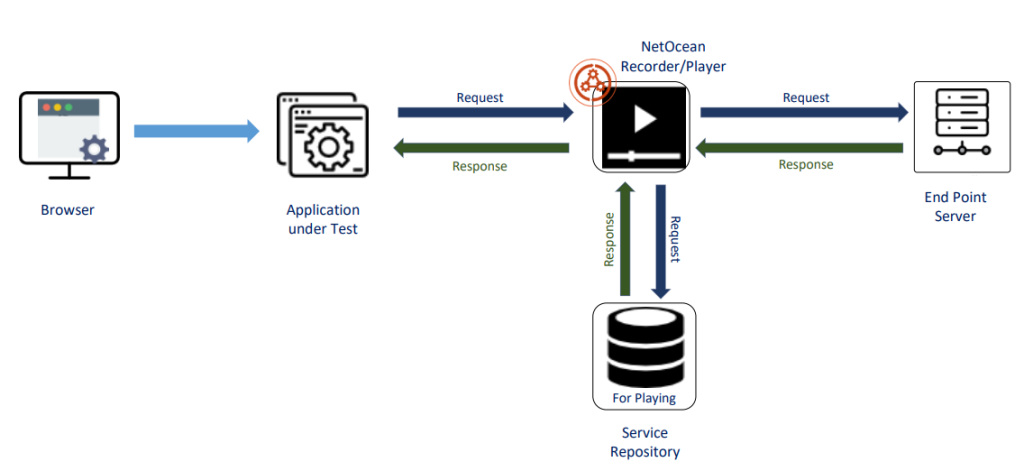
NetOcean captures and simulates the behavior and performance characteristics of backend systems and third-party applications in a production-like environment, making these characteristics available within the test environment for development and testing teams. Additionally, NetOcean allows for the customization of responses for simulated services and the application of boundaries or error conditions.
Conclusion:
Service virtualization (SV) is essential in modern software development, allowing teams to simulate dependent systems for more efficient and reliable testing. It helps overcome issues with unavailable or costly real services, leading to better software quality.
SV has evolved to support methodologies like DevOps and continuous testing, enabling parallel development, optimizing resources, reducing costs, and mitigating testing risks. Tools like Cavisson Systems’ NetOcean exemplify the practical benefits of SV by simulating backend systems and speeding up software releases.
In summary, SV enhances software development by improving integration, continuous delivery, and performance in complex environments.
Contact us to begin your service virtualization journey with us!
The Essential Guide to Service Virtualization
Category
- Blog (34)
- Chaos Engineering (4)
- NetStorm (3)
- Real Device Testing (1)
- Real User Monitoring (3)
- Service Virtualization (1)
- Uncategorized (1)